


Elongation at break is a key mechanical property used to measure a material's capacity for plastic deformation when subjected to tensile force until failure. It is defined as the total elongation of the gauge length at the moment of fracture, expressed as a percentage of the original gauge length. This metric directly reflects a material's toughness and ductility; a higher value indicates greater deformability prior to failure and superior resistance to impact and deformation, whereas a lower value signifies a more brittle material prone to brittle fracture.
Elongation at Break of PE Pipes
The elongation at break of PE pipes is a key indicator for evaluating the flexibility of water supply piping. Testing this property allows for the assessment of whether the pipe quality meets regulatory standards. Testing is conducted in accordance with ISO 6259-3 ("Thermoplastics pipes - Determination of tensile properties") at a constant temperature of 23°C. Tensile tests are performed at specified speeds using a tensile testing machine to determine the maximum elongation at break for the PE water supply pipe (≥350%)
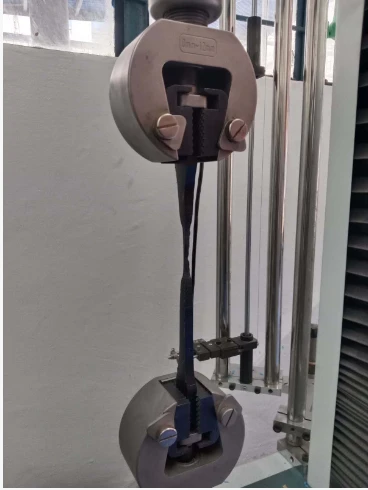
Test Principle:
Elongation at break is typically measured using an electronic tensile testing machine. During the test, the prepared standard specimen is clamped at both ends within the machine's grips, and a tensile load is applied at a constant rate. The machine simultaneously records load and displacement data to generate a stress-strain curve. When the specimen ruptures, the system automatically records the gauge length at the moment of breakage. Elongation at break is calculated by dividing the difference between the post-break gauge length and the original gauge length by the original gauge length.
Specimen Classification: Different material sectors employ specific specimen dimensions to ensure the comparability of test results. For PE piping, dumbbell-shaped specimens are commonly used, typically featuring a gauge length of 50 mm or 100 mm to facilitate clamping and measurement.
Significance of Testing Elongation at Break for PE Pipes
Elongation at break is a key indicator of a PE pipe's flexibility and resistance to deformation; it generally depends on factors such as material type, grade, additives, molecular structure, and manufacturing processes. In general, PE pipes made from materials like high-density polyethylene (HDPE) and linear low-density polyethylene (LLDPE) exhibit relatively good plastic deformation capabilities, resulting in higher elongation at break values.
In practical applications, the elongation at break for PE pipes typically ranges from 500% to 1000%, meaning the pipe's length can increase five- to ten-fold before fracturing under tension. This high elongation at break enables PE pipes to effectively withstand external impacts, deformation, and displacement, thereby helping to reduce the risk of rupture and enhance the pipe's durability.
Production Improvement Measures for Non-Compliant Sample Test Results
If test results fall below standard requirements (e.g., <350%), troubleshooting and improvements can be addressed in the following areas:
1. Raw Material Issues
Causes: Excessive use of regrind or recycled material; melt flow index (MFI) of raw materials is too low or too high.
Improvements:
Ensure the use of qualified virgin PE resin (e.g., PE80, PE100).
Control the proportion of regrind added (generally not exceeding 10%, ensuring stable performance).
Select a grade with an appropriate melt flow index (typically 0.2–1.0 g/10 min).
2. Improper processing conditions
Causes: Excessive extrusion temperature leading to thermal degradation; rapid cooling causing internal stress; excessive screw shear.
Improvements:
Lower extrusion temperature: Specifically, reduce barrel and die temperatures, ensuring they do not exceed 220–230°C (depending on the specific grade).
Optimize screw speed: Avoid excessive shear that could cause localized overheating.
Adjust cooling rate: Implement gradual, staged cooling to avoid rapid quenching (e.g., by raising the cooling water temperature or reducing the length of the cooling section).
3. Formulation and Additive Issues
Causes: Insufficient or ineffective antioxidants; uneven carbon black dispersion; excessive filler content.
Improvements:
Increase dosage or switch to high-efficiency antioxidants (e.g., 1010/168 systems).
Ensure uniform dispersion of carbon black masterbatch and control the content within the 2.0%–2.5% range.
Avoid adding non-functional fillers (e.g., calcium carbonate, talc).
4. Die and Extrusion Line Design
Causes: Incomplete melting or presence of weld lines; unsuitable compression ratio.
Improvements:
Enhance the screw's mixing capability (e.g., by using a barrier screw).
Optimize the die flow channel design to ensure uniform melt extrusion.
5. Post-processing and Storage
Causes: Failure to perform annealing after extrusion; exposure to UV radiation or moisture during storage.
Improvements:
Perform post-extrusion conditioning (such as holding the pipe in an 80–90°C water bath or oven for several hours, followed by slow cooling) to relieve internal stresses.
Store in a cool, dry place away from light; avoid prolonged outdoor exposure to sunlight.
In summary, the elongation at break of PE pipe is a critical mechanical property parameter; it reflects the material's deformability at the point of tensile failure and is essential for ensuring the reliability and durability of PE pipes in practical applications. However, it should be noted that specific values for elongation at break may vary depending on the material; therefore, these factors must be taken into account during material selection and engineering design.


Subscribe now,you will receive monthly valuable information.
Name : Email :
Tel: +86-311-89171989
E-mail: sales@chinatestequipment.com
Hebei Shijiazhuang Qiaoxi 368 Xinshi North, Road
Copyright © Honor Test technology Co.,Ltd. All Rights Reserved.


